
The Complete Guide to Digital Inspections for African Fleets: Vehicles, Plant & Equipment
Every fleet and industrial operation runs on inspections — a driver checking a truck before a delivery, a forklift operator running through a pre-shift checklist, a technician verifying a generator before it's needed in an outage. The question isn't whether inspections happen. It's whether they're actually captured, actioned, and available when you need them.
Across South Africa and the rest of the continent, most of that inspection data still lives on paper — in clipboards, carbon-copy books, and filing cabinets. This guide covers why that's a growing risk, and what a digital approach looks like across every asset class: vehicles, plant, machinery, and equipment.
FleetFabric©'s inspection app is free to download for every driver and technician on Google Play and the Apple App Store.
📌 What This Guide Covers
Why paper inspections are a growing liability — vehicle DVIRs — equipment and plant inspections — DVIR vs. equipment inspection compared — AARTO, OHS Act, and compliance — how the digital workflow works — and where to start for your operation.
Why Paper Inspections Are a Growing Liability
Paper-based inspection processes share the same failure points, whether the asset being checked is a delivery truck or a warehouse forklift:
- Records go missing. A damaged, lost, or never-filed sheet means no proof of inspection when an auditor, insurer, or investigator asks for one.
- Defects sit unseen. A fault noted on a paper form might not reach a workshop for days — turning a small, cheap repair into an expensive breakdown. See how that same defect-visibility gap plays out on the workshop side in our Digital Job Cards vs. Paper Job Cards comparison.
- There's no real-time visibility. Management only knows what gets manually reported, which in practice is often incomplete — one of the clearest signs your fleet needs maintenance software.
- Compliance exposure builds quietly. Whether it's AARTO requirements for vehicles or OHS Act obligations for machinery, a missing paper trail becomes a real problem exactly when you can least afford one.
- Insurance claims get harder. Insurers increasingly expect documented, timestamped proof of pre-use inspection before they'll settle a claim without dispute.
These risks apply equally to a fleet of delivery vehicles and a warehouse full of forklifts — which is why digital inspection has become standard practice across both.
Vehicle Inspections: The DVIR
A Digital Vehicle Inspection Report (DVIR) is a structured, electronic pre-trip or post-trip inspection completed by a driver on a mobile device. It's timestamped, geotagged, and immediately visible to fleet managers — unlike a paper sheet that might sit in a cab for a week.
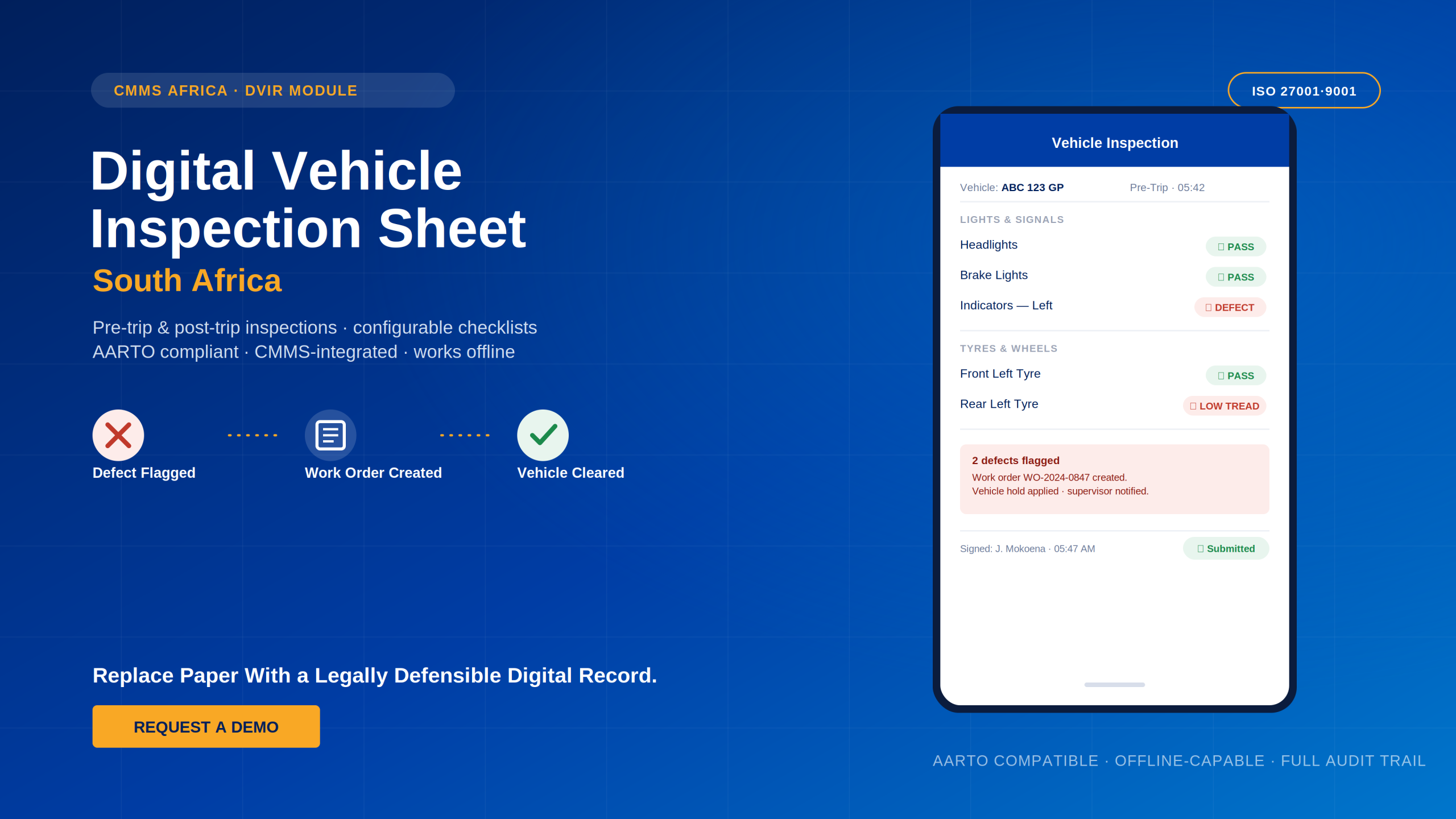
FleetFabric©'s DVIR — pass/defect status, automatic work order creation, and vehicle hold, from the dedicated Digital Vehicle Inspection Sheet page.
What a DVIR Typically Covers
- Lights & signals
- Tyres & wheels
- Fluids & engine
- Brakes & steering
- Body & structure
- Documents & safety equipment (licence disc, fire extinguisher, warning triangles)
When a defect is flagged, it becomes a work order automatically, and critical faults can place the vehicle on hold until it's cleared by a supervisor — preventing an unroadworthy vehicle from being dispatched. That single control is also one of the clearest ways digital inspection feeds directly into using fleet data to predict breakdowns before they happen, rather than reacting once one occurs.
Figures reported by FleetFabric© operators using DVIR-anchored preventive maintenance — see the full breakdown on the Digital Vehicle Inspection Sheet page.
Full detail: Digital Vehicle Inspection Sheet (DVIR) →
Equipment & Plant Inspections
Vehicles aren't the only assets that need daily or scheduled checks. Forklifts, cranes, generators, and plant equipment carry the same — sometimes greater — safety and compliance stakes.
The dedicated equipment inspection pages below are newly developed and will be live shortly — in the meantime, our Types of Fleet Equipment Maintenance guide covers similar ground.
Core Equipment Inspection Resources
By Equipment Type
By Industry
DVIR vs. Equipment Inspection: What's the Difference?
The underlying workflow is the same in both cases — configurable checklist, mobile capture, automatic work order on defect, optional hold until resolved. The difference is in what's being checked and why. Both feed the same CMMS, which is a distinct thing from inspection alone — if you're weighing whether you need a full CMMS or a lighter maintenance tool, our Fleet Maintenance Software vs. CMMS comparison lays out the difference.
| Vehicle DVIR | Equipment Inspection Sheet | |
|---|---|---|
| Asset type | Licensed road vehicles | Plant, machinery, forklifts, cranes, generators, tools |
| Primary regulation | AARTO / National Road Traffic Act | OHS Act, Driven Machinery Regulations, Lifting Machinery requirements |
| Typical trigger | Pre-trip / post-trip | Pre-use, shift-based, or scheduled interval |
| Common failure mode without it | Roadside breakdown, traffic fine, insurance dispute | Workplace incident, unplanned downtime, audit finding |
🥇 Most Operations Need Both
Running vehicle and equipment inspections on the same platform means one asset register, one compliance dashboard, and no gap between fleet and equipment data.
Compliance: AARTO, OHS Act, and Beyond
Digital inspection isn't just an efficiency play — it's increasingly a compliance necessity.
- AARTO & the National Road Traffic Act require operators to ensure vehicles are roadworthy before dispatch. A DVIR provides the documented evidence.
- The OHS Act places a duty on employers to take reasonably practicable steps to keep plant and machinery safe to use — a documented inspection process is central to demonstrating that.
- Driven Machinery Regulations apply to specific classes of machinery — compressors, pumps, and similar equipment — requiring scheduled inspection and valid certification.
- Lifting Machinery Inspection (LMI) requirements apply to cranes, hoists, and rigging equipment, with statutory inspection by an appointed inspector on top of day-to-day operational checks.
⚖️ Important Note
Digital inspection software supports and documents this compliance process — it does not itself certify legal compliance. Statutory certificates and formal inspections must still be issued by appropriately qualified, appointed inspectors.
Note: OHS Act, Driven Machinery Regulations, and Lifting Machinery (LMI) inspection pages are in development — check back soon, or explore the related compliance and maintenance resources below.
How the Digital Inspection Workflow Works
Whether it's a truck or a crane, the workflow is consistent from start to finish:
- Operator opens the app and selects the asset and inspection type — works offline if needed.
- Checklist is completed — pass, fail, or N/A per item, with photos for any defect.
- Digital sign-off — timestamped, geotagged, and signed.
- Automatic work order — any flagged defect is routed straight to the workshop or maintenance team, slotting into your existing maintenance planning and scheduling rather than sitting as a standalone note.
- Asset hold (if critical) — unsafe equipment or vehicles are blocked from use until cleared.
- Resolution & release — once repaired and signed off, the asset is cleared and the full record is retained, feeding your job costing and overall fleet budget in the same platform.
Where This Fits for Your Operation
Most operations end up running vehicle and equipment inspections side by side — on one CMMS, against one asset register, with one compliance dashboard.
- Running a transport or logistics fleet? Start with the DVIR.
- Running warehousing, mining, or construction equipment? Start with the Digital Equipment Inspection Sheet.
- Not sure whether your fleet is even at the point where you need this? Our Fleet Maintenance 101 guide for beginners and Signs Your Fleet Needs Maintenance Software are good starting points.
- Comparing platforms? See our Top 10 Fleet Maintenance Software in South Africa roundup.
- Operating in a specific region? See our location-specific fleet management pages below.
- Need to document compliance? See the AARTO and asset management resources above.
Frequently Asked Questions
Do I need separate systems for vehicle and equipment inspections?
No — FleetFabric© runs both from the same platform and app, against a single asset register.
Does this work on remote sites with no signal?
Yes. Inspections are captured offline and sync automatically once connectivity is restored — essential for mining, agriculture, and remote construction sites.
Can checklists be customised per asset type?
Yes, every checklist — vehicle or equipment — is fully configurable by asset class, industry, and site.
Does a digital inspection replace a statutory certificate (e.g. LMI, COF)?
No. Statutory inspections and certifications must still be performed by appropriately qualified, appointed inspectors. Digital inspection software tracks and stores those certificates alongside your own operational checks — it doesn't replace them. Learn more →
Is a DVIR available on both iOS and Android?
Yes — the FleetFabric© app is available on both Android and iOS, and works offline on both — see the full Digital Vehicle Inspection Sheet page for the mobile walkthrough.
Conclusion: One Platform for Every Inspection
Whether it's your vehicle fleet, your forklifts, your generators, or your entire plant inventory — bringing inspections into one configurable, auditable digital workflow closes the gaps that paper leaves behind: lost records, delayed defect resolution, and compliance exposure that only surfaces after something's gone wrong.
FleetFabric© runs vehicle DVIRs and equipment inspection sheets on the same CMMS platform — one asset register, one compliance dashboard, no gap between fleet and equipment data.
Further reading:
→ Digital Vehicle Inspection Sheet (DVIR)
→ Best CMMS Software in South Africa
→ Work Order Software for African Fleets
→ Digital Job Cards vs. Paper Job Cards
→ Types of Fleet Equipment Maintenance in South Africa
→ Asset Register Best Practices
→ Fleet Maintenance Software vs. CMMS
→ Using Fleet Data to Predict Breakdowns
Ready to Replace Paper Inspections?
FleetFabric© brings vehicle DVIRs and equipment inspection sheets into one CMMS platform — configurable checklists, automatic work orders, and full compliance documentation. Start your free 15-day trial — no credit card, no commitment.